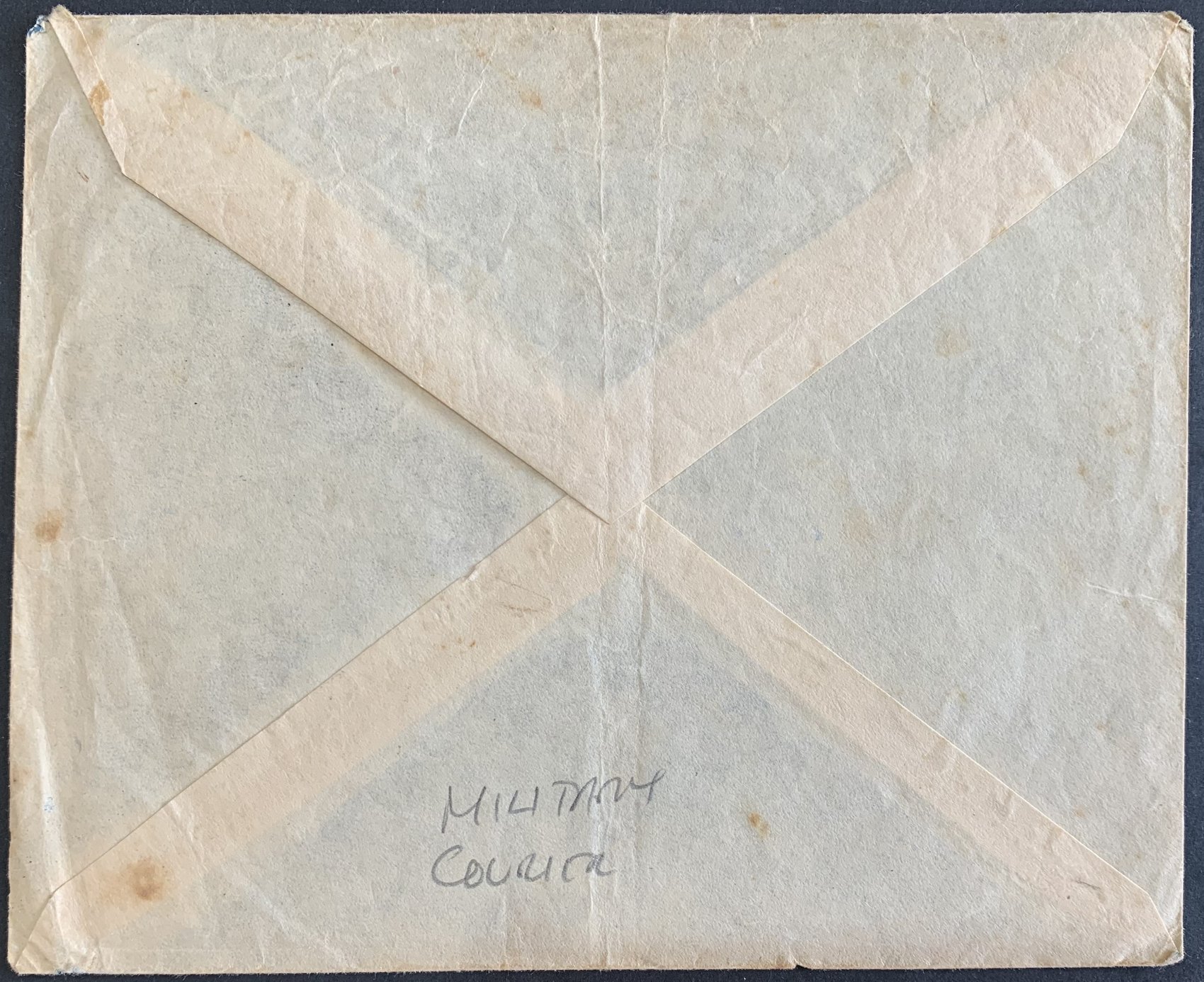
Cracking the riddle of the dateless APO 3 postmark - a supporting 'proving cover': a plain stampless cover, without return address or army postal unit triangular KABA handstamp, addressed to "
Family [of] Refael Levi, 52 Sokolov Street, Tel Aviv" & tied at top right by a single strike of a black
dateless APO 3 postmark.
As per extensive research conducted by this cataloguer on the subject of 1948 mail with Jerusalem and the army postal service (published in
JerusalemStamps Bulletin #3),
there were at least 3 different types of dateless APO 3 postmarks in use, either
in black or violet-brown ink (APO 3 being the army post office in TEL AVIV), such that the common theory that there was just one and that it dates to 22-30 May 1948, before the receipt of its date-slug (according to that theory),
is without foundation.
From further research, this cover was most likely sent by
Rafael (Yaacobson) Levi, a member of the Palmach who served in the 4th battalion ('HaPortzim' - The Breechers) of the Harel brigade in the area of Jerusalem and the land corridor leading up to it. Levi was severely wounded just before the 1st Truce of 11 June, at Kiryat Anavim, and
his unit and wounded soldiers from Jerusalem were transferred to Tel Aviv during the 1st Truce (11 June - 8 July) for reorganization and medical treatment: his service record together with that of another soldier whose extensive correspondence also includes a mark-less letter like this with a dateless APO 3 postmark on the top right, helps establish that this dateless postmark was
in use at least in June.
The rarity of this cover is its simplicity, lacking any army markings or even a return address -
stripped to its essentials but being a genuine piece of mail: virtually all other covers bearing the dateless APO 3 postmark bear all manner of markings usually hinting at them having been "flown" - but
these embellishments hinder accurate research into the circumstance of the dateless postmark's use; this is only the 2nd such plain cover seen and examined by this cataloguer. In all cases
the dateless APO 3 postmark is never seen on mail bearing a KABA handstamp, but the reason for this until now has been unclear: here now, as on this cover lacking any markings whatsoever and especially any reference to an army postal unit number or even the sender himself - and the postmark itself lacking a datehead - this cataloguer's assessment is that this was
likely a postmarking device used on letter-box mail sent from facilities which had not yet been issued a KABA army postal unit number (and there are indications
that this type of "APO 3" postmark may have been used at other APOs and not just at APO 3);
the lack of any identifying details whatsoever is likely a censor regulation, with the dateless postmark serving to
obfuscate its time of dispatch (the interim period sorting office of the civilian postal service in Jerusalem similarly used a dateless 'rosette' postmark to process letter-box mail). As per the taxonomy used in the research to be published, the postmark used on this cover is "
type 3" with a
downward slanting letter YUD (when the postmark is observed perfectly horizontally). Opened gently at back, vertically folded.
Rare postal history representing part of the solution to a 75 year-old philatelic mystery. An illustration of the 3 observed postmark variations is shown at the end of the display. Ben-Arieh certificate enclosed.