Description
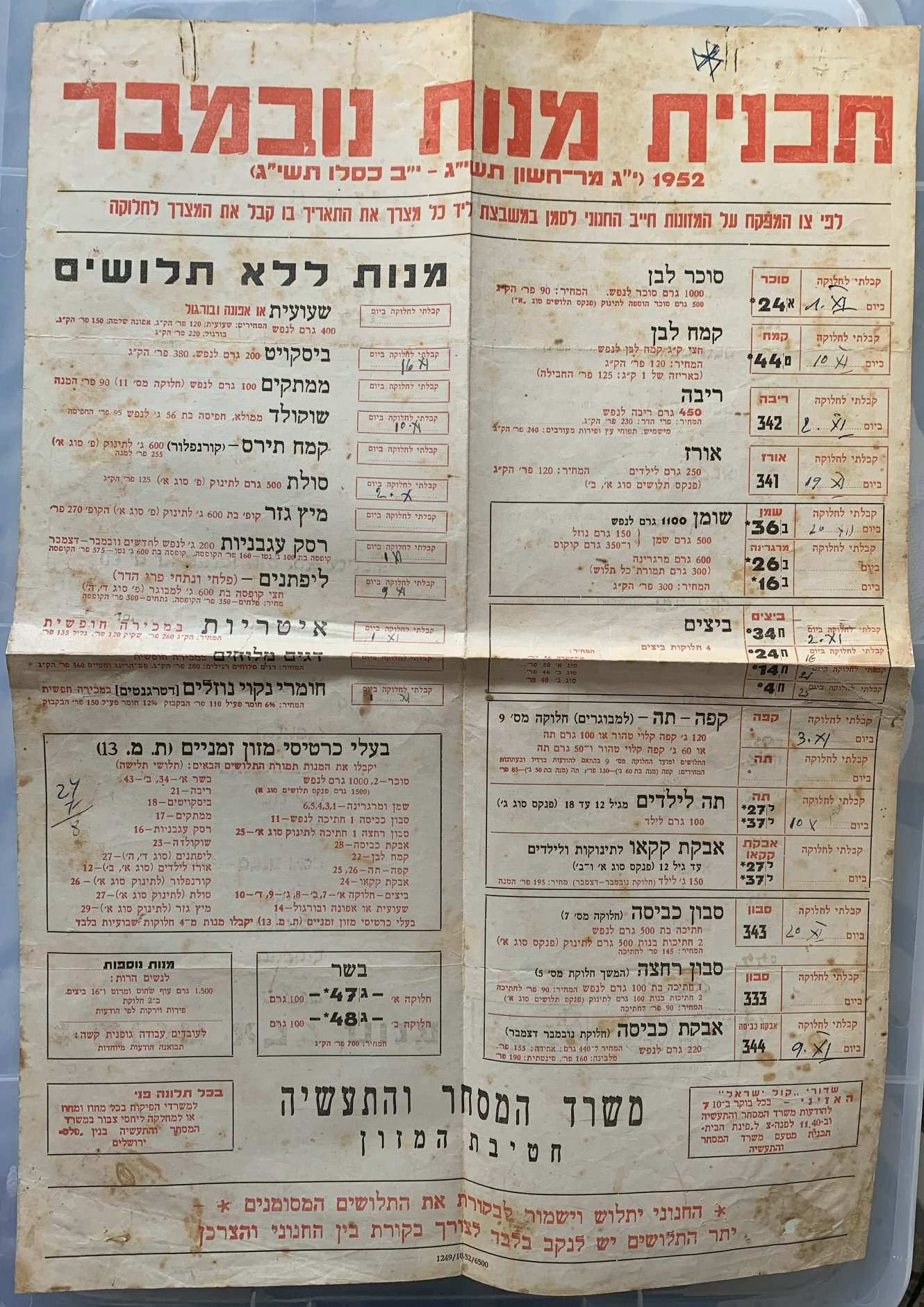
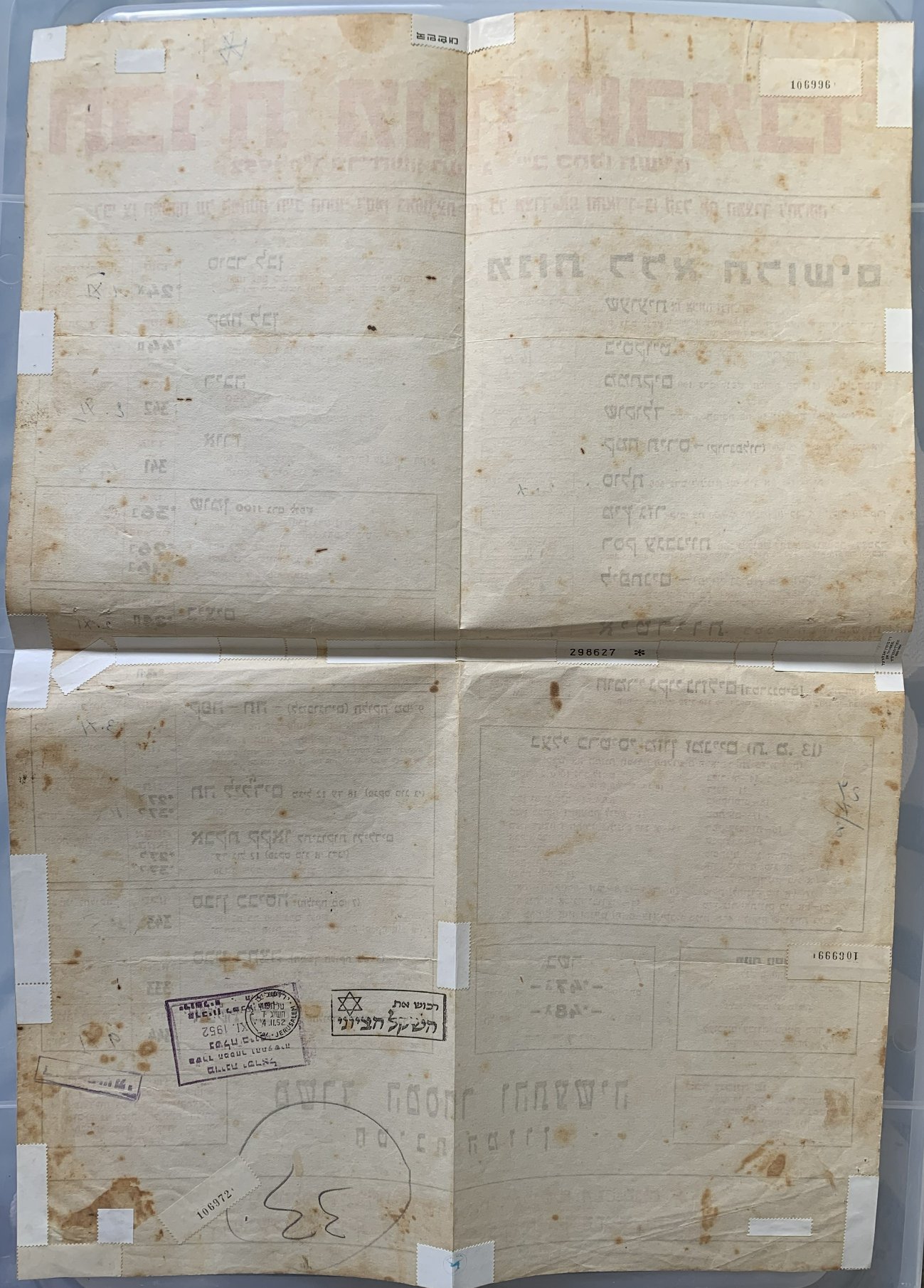
Original Israeli austerity-period ('Tzena') food program price list poster for Nov 1952, mailed (on reverse) by the Ministry of Trade and Industry in JERUSALEM on 4 Nov. 1952 and machine slogan postmarked the same day - mailed postage-free as official mail. This public announcement was issued by the Ministry of Trade and Industry's Department of Food and intended for display at a participating grocery shop; the price list is filled in by hand with the arrival dates of the grocer's supplies.
The broadsheet's headlines read: "Ration Program for November | (13 of the Hebrew month of Marcheshvan 5713 - 12 of the Hebrew month Kislev 5715) [Nov-Dec] 1952 | By Order of the Inspector of Foodstuffs the Grocer is Required to Mark in the Grid by each Good the Date on Which He Received the Good for Distribution"; the announcement is then subdivided into three main sections - one for "Rations Requiring Ration Coupons", one for "Rations not Requiring Ration Coupons" and one for "Holders of Temporary Food Cards". In later years, like 1955, when the supply situation improved there was also a section for foodstuffs for "Free [Open] Sale".
The sections list the price (in Prutot) of foodstuffs, soaps, cleaning and detergent materials by weight - such as sugar, jam (by flavor), rice, oil, eggs, coffee, tea, sweets, chocolate, meat; in later years these notices would include also "imported cheese", "filled chocolate", filleted fish and meat, salted and frozen fish, and more. There is a special box for "Additional Servings" for pregnant women and for "Workers Doing Hard Physical Work - details will be forthcoming".
The pricelist is signed by the Ministry of Trade and Industry's Department of Food and includes a reminder at the bottom that the Voice of Israel radio broadcasts annoucements by the Department at 7:10 every morning, and that on certain days at 11:40 it airs a program sponsored by the Department. Citizens with complaints are asked to come to the relevant office in the "Peles" building in Jerusalem.
The austerity period (known as the 'Tzena') took place between 1949 and 1959: to cope with shortages of food and raw materials as a result of the War of Independence, the absorption of a million new immigrants, the need to stabilize the local currency and economic sanctions by neighboring Arab states, Israel instituted an austerity program in April 1949 based on coupons and points, which allocated pre-determined amounts of foodstuffs and, later, other materials to its citizens.
The program was originally led by Canadian-born lawyer Bernard (Dov) Yosef - former civilian commander of wartime Jerusalem - and the then "Minister of Austerity", and the allocation of foodstuffs was determined by an American expert. The newspapers would announce the time and area of food distribution, along with the price and necessary coupon booklet vouchers for the acquisition. The program later grew to encompass clothing, furniture and even housing, serving as a method of establishing a national "bottom line" standard of living and Israeli-styled tone to daily social standards. Folded into 4 quarters and reinforced along the folds by postage stamp gutters; a small hole at the bottom right from removal from a display board.