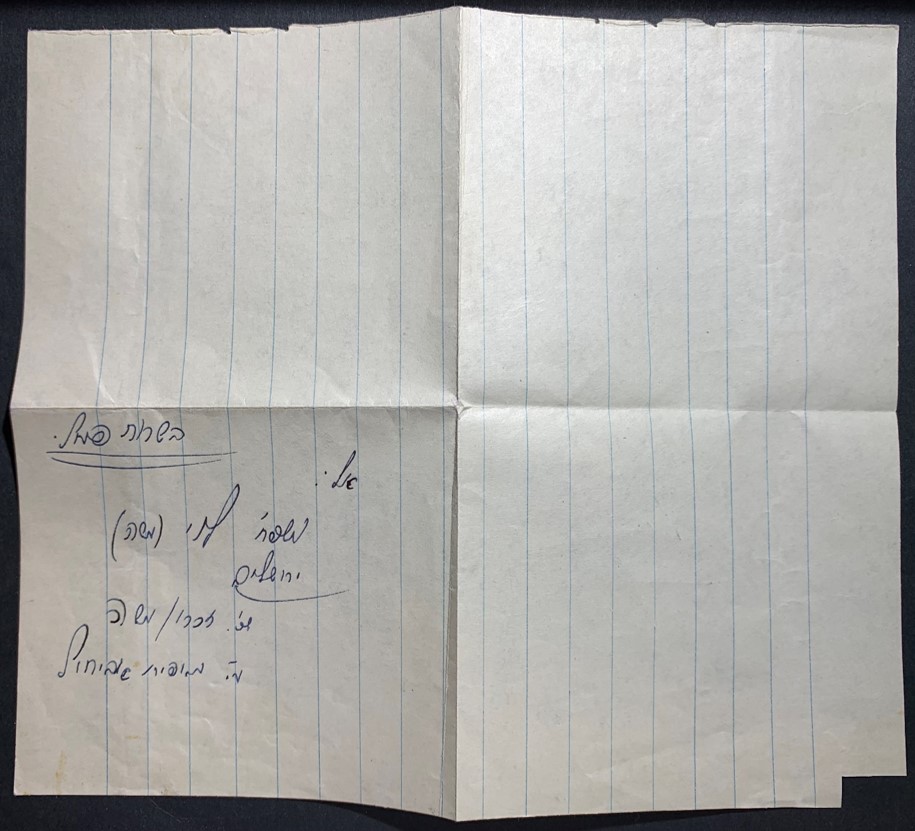
Key 1948 Army mail proving cover: undated stampless cover with original pen
written letter inside, Hebrew dated Alef Sivan 5708 (
8 June 1948), signed "Shmuel" [Rubkhash] with his unit number "
211/25" & bearing on its backside the endorsement "
on active service" together with the address Moshe Levi Family near the Avihayil Bakery at the Zichron Moshe neighborhood [next to Mea Shearim] in "JERUSALEM" and
signature signed by his officer "Weitz", below the letter - to enable it to be sent postage free as army mail "folded letter". The cover is identically OAS endorsed & addressed - in different handwriting and in pencil - with return address written as Private Shmuel Rubkhak(sp) at army postal unit 211/25 (63rd battalion of the 'Etzioni' Brigade). The cover is tied by the unit's triangular KABA handstamp & signature endorsed by the same officer, Weitz.
The cover is tied by both a rosette postmark of the Jerusalem civilian postal service's sorting office as well as a
13 July 1948 dated large "provisional" postmark of Army Post Office APO 5 (Jerusalem) - over a month after the letter was written. The letter itself was
written the day after the Army Postal Service began operating in Jerusalem (enabling postage-free soldiers' mail),
still during the intense war period prior to the 1st Truce of 11 June.
The letter was evidentally
written in a situation where postal services were inaccessible to the writer: the letter itself was initially prepared to be posted on its own as stampless mail but later entered into a prepared KABA pre-stamped envelope, whose officer signature + "on active service" endorsement enabled it to be dispatched for mail as legitimate postage-free army mail; the cover is properly return-addressed and officer endorsed as per the regulations.
There is little and even conflicting information on the assignment of the referenced KABA number: it may have belonged to the
'Mechmesh' combat battalion or to
'Metzuda' [garrison] Battalion A; 'Mechmesh' was disbanded on
21 May owing to its heavy casualities with its surviving members reassigned to other units of 'Etzioni', and the postal unit number (and battalion number) may have been reassigned to the 'Metzuda' unit. In any case the military units in the district remained in or near the city, so
this letter was posted within the district.
From the postal markings it appears that the
cover was entered into a letter box and later processed by the sorting office civilian postal service which applied the dateless 'rosette' postmark to the face of the cover, although there is no way to know when (prior to the subsequent army datestamp) this occurred. Although the civilian postal service was responsible for the delivery of army mail it seems the civilian postal service here
transferred the letter over to the Army Postal Service first - perhaps to confirm that it was entitled for postage-free service - and the APS's army post office in Jerusalem (APO 5) tied the cover with its "provisional" datestamp on 13 July, prior to the letter then being returned to the civilian postal service for actual delivery.
This is the only military-originating army mail postal item known to have been deposited with the civilian postal service. Torn open at back but complete.
This is a legendary cover in the annals of Israeli Army postal history as well as interim Jerusalem postal history: this is the only known piece of 1948-49 army mail bearing the interim rosette device -
here as a transit mark - no other army mail is known stamped by the rosette (which is rarely seen as a transit mark, mostly it is observed cancelling uncancelled franks on mail entered into letter boxes).
Further, as bearing the rosette postmark in a somewhat deformed state, this cover has served as a supporting proof for a certain theory pertaining to the period of use of both the rosette postmark as well as the "provisional" APO 5 postmark, as formulated by some researchers and philatelists: this cataloguer has published research
proving that more than one rosette postmark existed and that the supposed last date of use of 20 June 1948 is without substantiation. On the back of that erronious supposition some philatelists who argue that the "provisional" APO 5 postmark was decomissioned after 18 June have tried to demonstrate with this cover that if the rosette device was decommissioned on 20 June the "provisional" APO 5 postmarks dated in July must all be mis-dated and should be backdated a month to June. By that logic the solder wrote his letter on 8 June, the Army processed the letter on 13 "June" and mysteriously the cover was handled by the Jerusalem civilian postal service's sorting office prior to delivery. This cataloguer
has also disproved this theory by way of a proving cover conclusively showing the "provisional" APO 5 postmarks in use in July (see Rosette article in
JerusalemStamps Bulletin #1). More information disproving these theories, and casting light on the postal operations of the army in this period is published in
JerusalemStamps Bulletin #3.