בס"ד | Our Online Store was updated 7 October 2026
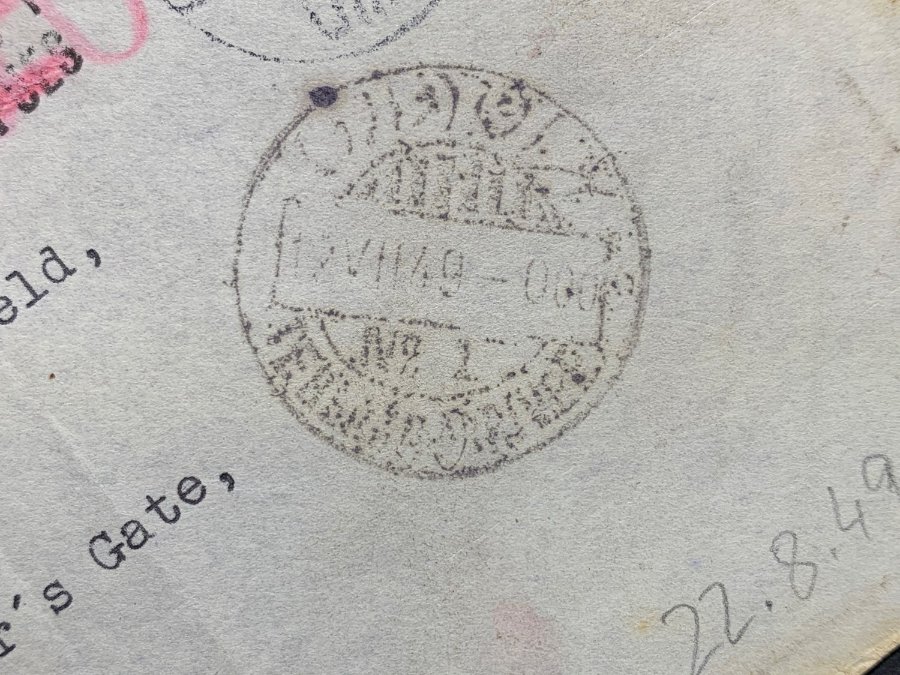
1948-49 War era postal boycott air mail to Israel via Iran - discovery piece: 9 JULY 1949 airmail commercial cover on business stationary from COPENHAGEN Denmark to HAIFA "Israel", franked 1.40Kr per period postage rate plus extra weight (per pencil notation on front extra 50 ore for 8g additional weight - hence 'orphaned' stamp below the rest tied by handstamp postmark) & tied by local machine cancel; front-stamped 12 (or 18) VII 49 TEHRAN transit & subsequently marked by the rare Syrian 3-line French-language instructional marking handstamp "RETOUR A L'ORIGINE | COMMUNICATION AVEC PALESTINE | INTERROMPUES" (Return to Origin | Communication with Palestine | Interrupted) Kibble Type-I, applied in DAMASCUS sometime just after 12/18 July; a blue crayon arrow was added, pointing to the Danish stamps indicating "return to sender" (at the preprinted address on the front).
As per the markings the cover was carried by SAS (Scandinavian Airline System) on its eastern route from COPENHAGEN to TEHRAN; although SAS had a direct service from TEHRAN to DAMASCUS the transit stamp (rare on non-registered mail) indicates the mail bag was opened: the leg to DAMASCUS could have been taken by SAS (which until at least mid-April 1948 had serviced Lydda directly from Tehran) or Iranian Airways (which had in the past flown directly to Lydda, as a subsidiary of TWA). It does not appear that the cover was misrouted: SAS had a more direct route to Cairo from Copenhagen (i.e. to reach Jordanian-Palestine), but the mail dispatch appears to be an attempt to circumvent Cairo in order to reach Israel. Nevertheless at this time SAS did not have direct or even indirect connections from Europe to Israel and it appears that the cover was dispatched haphazardly, depending on improvised transit by local Arab airlines to complete the transmission.
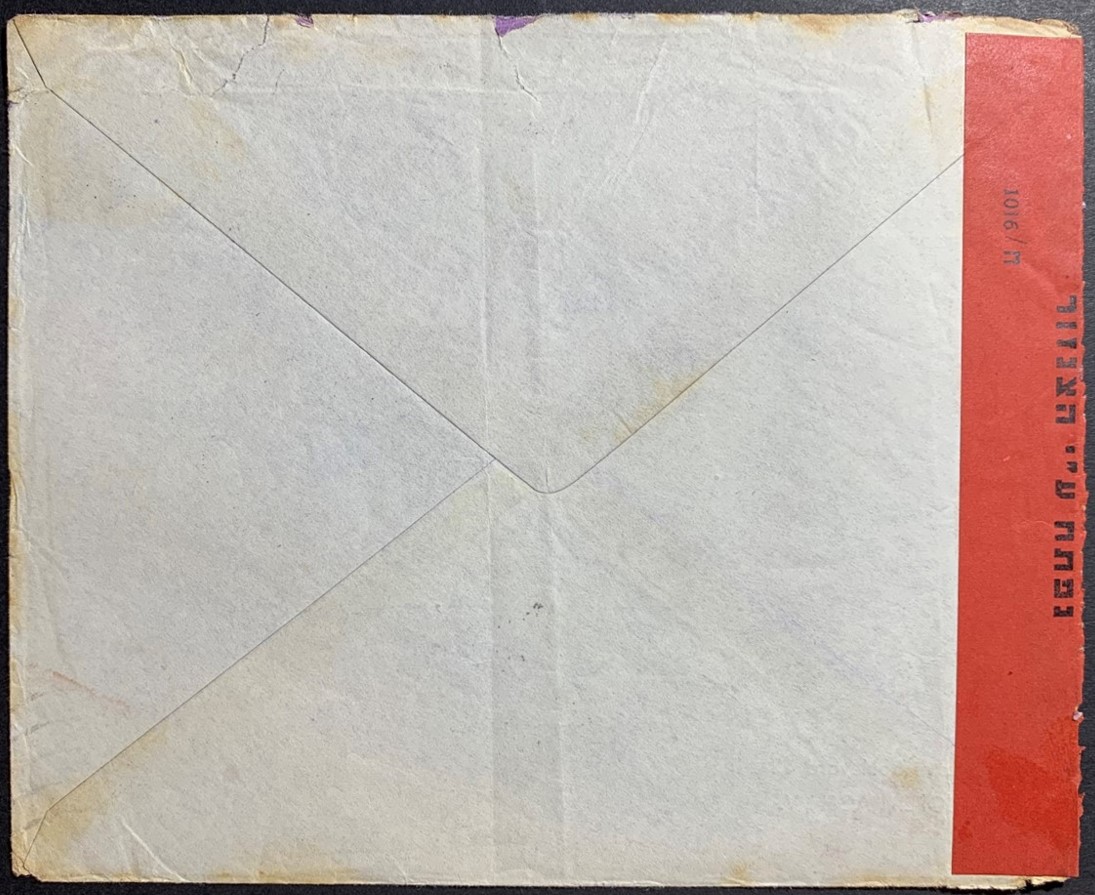
The cover was subsequently resent on 22-8-1949 per postmark on front - without additional postage, as not required by the UPU for such returned mail; at this stage the Syrian IM was probably struck out by the red crayon - and the cover was routed such that it reached Israel, where it was opened & resealed by the Israeli military censor in Haifa, Chet 1016 & stamped approved by Chet 17.
A remarkable cover: until now, per Daryl Kibble's research the Syrian instructional marking was supposedly in use only from January-March 1949 during a period where her airlink to Palestine (via Jordan) was cut off by the War of Independence (in fact Arab transport links to Israeli-Palestine were effectively lost with the transfer of Haifa airport to Israel in May 1948); less than 5 such covers are known to him - 4x to Jerusalem & 1x to Tel Aviv, none from Denmark and only one with Beirut routing (probably via Lebanese Middle East Airlines). At this time, Syrian Airways had ceased operation since 1948 (until 1951) owing to financial problems but an air link between AMMAN and KALANDIA (north of Jerusalem - the closest possible location to Israel) had just been inaugurated on 26 June and this cover could have been forwarded to Jordan - as the final transit point - for sorting, as was normally done. Nevertheless the cover was not transmitted onward - as such, here the IM was in use as late as July 1949 (about 4 months after the War; wartime hostilities ended on 10 March and an armistice with Syria was signed 20 July) and employed as a refusal of service marking making this the earliest known & documented instance of handstamp-marked Arab postal boycott mail (BAPIP Bulletin #54 p.16-17 reports a 26-05-1949 postmarked cover with a Jordanian "Pas de Communication" refusal of service handstamp - but this was not seen or photographed; the earliest manuscript-marked refusal of service is from Ir aq, dated 11 June 1949, Kibble p.166).
More remarkable is the Tehran routing: official postal relations between Israel & Iran were renewed in January 1951 (and ceased again in 1982), and Iran was not part of the Arab postal boycott of Israel; the Iranian postal link to Israel became established between those years, but remarkable here as so early + from a European origin. Cover slit open at top & left, some peripheral tears at top - but very fine postal markings affected by this. Ben-Arieh certificate enclosed.